

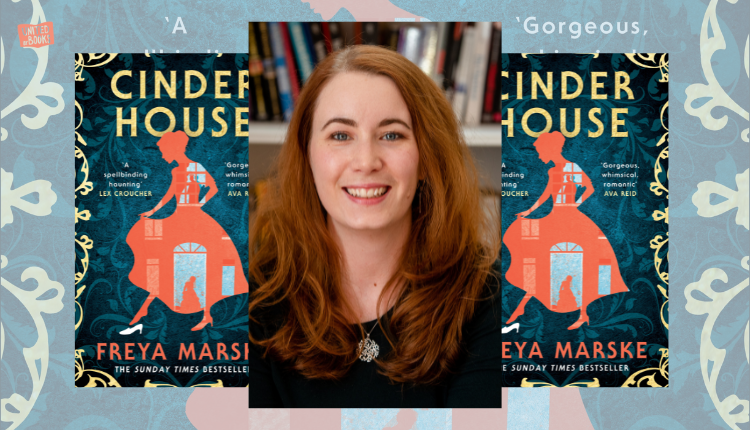
Freya Marske reimagines Cinderella in Cinder House
Freya Marske shares how she twisted the iconic Cinderella tale into Cinder House, a haunting, romantic fantasy about identity.

Retelling one of the world’s most familiar fairy tales is no small feat. In Cinder House, Freya Marske takes the bones of Cinderella and reshapes them into something dark, lyrical, and entirely her own. Blending ghostly magic, political intrigue, and a deeply personal exploration of chronic illness and selfhood, Marske’s latest novel proves that even the oldest stories can be reborn. We spoke with her about crafting her version of the classic tale, the power of transformation, and finding new meaning in happily-ever-after.
Cinderella is one of the most frequently retold fairy tales. Did you find it more challenging or easier to work with such a well-known story as your foundation?
The familiarity of the tale was definitely a double-edged sword! Everyone’s heard at least one version. Perhaps five or ten. And so unlike with a fresh original tale, where people aren’t bringing any preconceived ideas to it, I felt a need to be constantly proving that my version was worth someone’s time. That it was unique enough and held enough of my own voice and ideas.
But at the same time, diving into a story so rich in iconography and tropes, where I could pick and choose my favourite ones—take them in both hands and lovingly twist—was a wonderful feeling. A blank page is a lot less scary when you can pin up a glass slipper, and the concept of midnight, and begin to work outwards from there.
What inspired your version of the tale? Did you draw more from the darker original folklore, or from modern adaptations that came before yours?
You have no idea how much I wanted to include someone having some toes chopped off, but alas! It didn’t fit with the story and the tone in the end. Ironically, I think the two versions of Cinderella that fed into mine most directly are Ella Enchanted by Gail Carson Levine—I’ve only ever read it once, but the idea of magically enforced obedience fits well in a fairy tale about a fall from rich daughter to servant—and, uh, Sondheim’s musical Into the Woods. I adore a good fairytale pastiche. And spent more time than I’m proud of singing “I wish to go to the festival!” to myself.
In Cinder House our Prince Charming already has a love interest apart from Ella due to the, well, nature of her existence, and that is Princess Nadya – was it hard to incorporate her into the story?
Oh, absolutely not: the character of Princess Nadya was in my head from the very early stages of planning the story. It’s obviously part of the fairytale that the heir to a kingdom is allowed to choose his bride from amongst a crowd of total unknowns, but the part of me that loves both political intrigue and an arranged-marriage romance wanted to complicate the picture. What if our prince, like many princes, is expected to make a deliberate alliance? What if he, like Ella, is not entirely free?
The question then became what I wanted to do with Nadya to make her a more interesting and fundamental part of Ella’s story. I had a great deal of fun with her, in the end.
Fairy tales are often used to explore deeper themes. What themes were most important to you in Cinder House, and how did the ghostly twist help you bring them out?
This is a story about how our conception of self is always, to some extent or another, at the mercy of the body we inhabit. I wanted to explore the journey of emotions a person can go through when they feel suddenly betrayed by, and wrenched away from, the young healthy body they assumed they would always have. It’s a story about chronic illness. And about painstakingly reworking the sense of the future to encompass limitation, and insisting on being a full person with a full life.
Ella spends the whole book coming up against her limitations and being so, so angry about them—and then taking steps to work out what she has to accept, and what she is able to change. The ghost part is obviously fundamental to that, but transformation is also one of the central themes of the Cinderella story in any form. This one just doesn’t use pumpkins.
Fairy-tale retellings often come with strong reader expectations for how the story “should” end. Without spoiling anyone, how did you approach balancing those classic expectations with your own creative twists?
I love a happy ending. I wanted Ella’s to feel earned, and to leave the reader with a solid understanding of what that happiness would look like, in the months and years to come. That’s the mark of a well-done romance, I think.
But I also didn’t want anyone to simply wave a magic wand and resurrect my ghost-girl; the ending, by necessity, had to be more complicated than that. As long as the happiness was there, I gave myself free rein to go off in some, uh, slightly wild directions. And I’m very pleased with the result.
Cinder House by Freya Marske is out now (Tor UK).
