

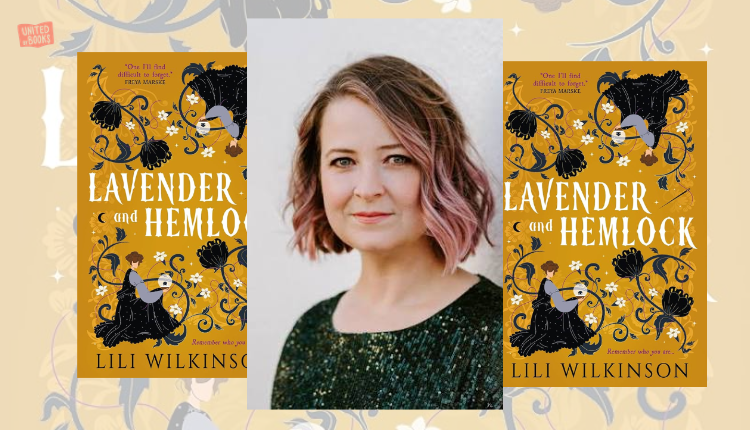
Lili Wilkinson on Choosing Pocket Universes in Lavender & Hemlock
From glitzy royal balls to peaceful seaside villages, Lili Wilkinson discusses building worlds, playing with time and writing a fantasy about the choices we make.

What if you could escape the chaos of the world and find somewhere quiet to raise chickens? In Lavender & Hemlock, Lili Wilkinson creates a series of pocket universes where two girls navigate different worlds, five centuries of history and an unexpected romance. Wilkinson shares the inspiration behind her fantasy novel, the challenges of building its many worlds and why, ultimately, the story is about the choices we make.
Guest post by Lili Wilkinson, author on Lavender & Hemlock.
I started writing Lavender & Hemlock because I was angry at a Star Wars movie. I mean, if you establish that the Bad Guys are actually brainwashed child soldiers who are capable of redemption, then maybe the Good Guys shouldn’t just… kill them all? Doesn’t everybody deserve a choice? And what if everything was way more complicated than Good Guys and Bad Guys, and you didn’t really want to be one or the other, you just wanted to go somewhere quiet and raise chickens?
That was only the beginning, though. I needed characters – a wounded dark knight who just wants to be one of the good guys, and a lonely housemaid with no memory. I knew I wanted the Oubliette to be like a pocket universe – a cosy, dreamy place outside of time and space where you could be safe from the terrible events of the world. And once I’d created one pocket universe, it seemed a waste of story potential not to create more.
I love a challenge. I’ve written fantasy novels about corrupted magical power plants, about misogynistic toad cults, about demonic teachers and possession. Why shouldn’t Tansy and Merit be able to slip into any number of worlds? How fun to hop from glitzy royal balls to peaceful seaside villages, from bleak battlefields to magical workshops.
I may have gotten a bit carried away. There were worlds that ended up getting cut – my favourite was a society of peaceful genderless storytellers living inside a mountain. Perhaps I’ll use them in another book.
Timelines were tricky. Without spoiling too much, Tansy and Merit get to hop not just through space, but through time. The gap between Merit’s world and Tansy’s is five hundred years, and we get to see glimpses of what has happened in between. As I edited, some of these got shuffled around and required a great deal of braining to figure out who knows what and when do they learn it. I’d love to say I had some clever spreadsheet to keep track of it all, but I did not. My profound thanks and apologies to the editors who helped me to wrangle it all.
One of the biggest challenges was keeping the whole thing in a classic fantasy context, while showing that passage of time. What technological changes happen? How do fashions change? Speech? Finding a balance of how much to explain, and how much to just hint at is always a challenge, especially for writers of speculative fiction. In my experience it very much depends on the book – some stories demand a great deal of world-building and magic-system-explanation. In others, magic can just be magic. For me, I’m fascinated by the contents of a pocket universe, and the motivation of the character who creates it. I’m not really interested in the mechanics of how to build one, so there is less of that kind of detail in Lavender & Hemlock. There is, however, a scruffy grey dog. And a haughty cat. And a cantankerous goose. And two girls falling in love, through time and space.
Every book is ultimately a series of authorial choices, and I really wanted this to be a book about choices. About how good and evil don’t really exist – all we have are the choices we make, and we all make them every moment of every day.
Lavender & Hemlock by Lili Wilkinson is out now (Titan Books).
