

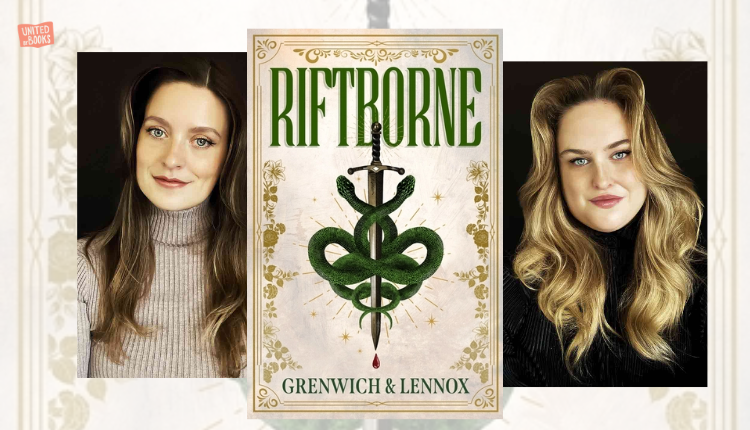
Grenwich and Lennox on ‘Riftborne,’ D&D and writing together
The co-authors' writing process grew out of collaborative storytelling, character backstories, and imaginative risk-taking.

To be clear, we did not take up D&D as a novel-writing exercise. And yet, here we are.
Writing a book together had never even occurred to us. We’d both had our own projects, of course. Ideas. Enthusiasm. Thirteen chapters of something you were convinced was going to be the one, right up until the inevitable afternoon you close the laptop and quietly never open the file again. What we didn’t have, back then, was any real idea how to build a world from nothing. Or the kind of trust you need to write a smutty-ass scene with another person without wanting to die. Sable Sorensen, we need to compare notes.
Then D&D happened to us.
If you’ve never played, we’ll spare you the battles and the demogorgons. D&D is really about agreeing, as grown adults, to be a bit ridiculous on purpose. You make up a character on a Tuesday night and by Thursday you are genuinely upset about her childhood. You improvise your way through a situation nobody planned for, and somehow land on an emotional beat that feels true, for a person who does not exist, in a place that is also not real. When six people are all bringing their whole weird selves to a table, you can’t half-commit.
We were on the phone doing what we always did before a new campaign, which is talk about our characters’ backstories for hours. Not “she’s an elf rogue with a dark past” but why the dark past. What it cost her. How she moves through the world differently because of it. Years of D&D had taught us to think like that without us ever noticing we were being taught.
So we were talking, and spiralling, the way we do. One idea fed the next, and eight hours later we hung up and realised we had not been talking about a campaign for a while. We had the bones of an epic trilogy.
As a Scorpio and Pisces duo, imagination was never the issue. What D&D gave us was imagination that had been put through its paces. Stretched, embarrassed, forced to adapt in real time, for years. Your instincts sharpen in ways you genuinely don’t even realise until they just start working.
And the vulnerability thing might matter most. D&D taught us to pitch wild ideas without blushing or cringing, which is the same muscle that let us write Riftborne from our actual fears and not just our interests. Being brave at a table gave us the nerve to be brave on the page.
And so as it turns out, five years of pretending to be elves was, indeed, research after all.
