

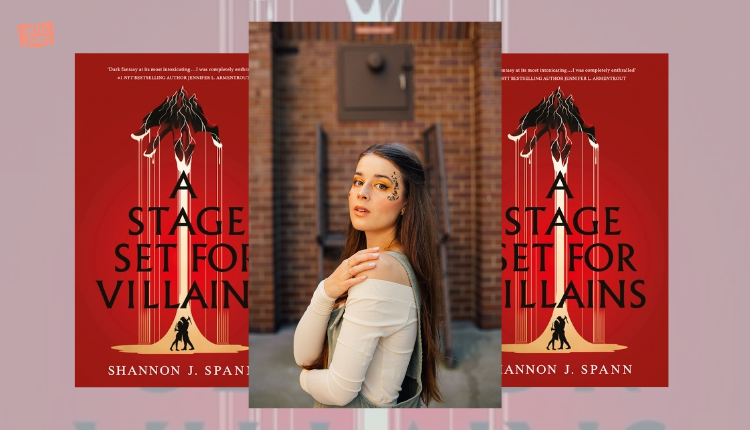
A Stage Set for Villains: Shannon J. Spann on Theatre, Villainy, and Dark Fantasy
Shannon J. Spann discusses her debut dark fantasy A Stage Set for Villains, where theatre, magic, and morality collide.

Dark fantasy meets theatrical spectacle in A Stage Set for Villains by Shannon J. Spann. Set inside the sinister Playhouse and ruled by godlike Players, the novel follows Riven and Jude as performance, power, and morality blur into something far more dangerous. We caught up with Samantha to talk debut nerves, theatrical magic, and why villainy sit at the heart of her haunting fantasy world.
This is your debut novel, and it introduces such an immersive and ambitious world. Looking back, what surprised you most about writing and publishing your first book?
On the writing front, A Stage Set for Villains surprised me more often than not! A friend asked the other day to see my outline for this book, because it “must be wild” and I had to admit that there wasn’t one. I tried and failed to outline it multiple times before accepting this was a “get on the rollercoaster and see where it goes” story. It seemed if I wasn’t surprised, I had no chance at surprising the reader either, so I like to think we sort of discovered Riven and Jude’s story together. Several of the twists caught me off guard, unfolding organically as the story unraveled. I like to whimsically think of it like I was just watching a play from backstage, gathering little bits and pieces from the wings.
The Playhouse and its godlike Players feel like a perfect blend of theatre and dark fantasy. What drew you to merging performance, spectacle, and danger into the heart of this world?
Theatre and performance have always been deeply intertwined with who I am as a person. Even off the stage, my “theatre kid” nature has been a universal key to many opportunities and experiences in my life that I treasure. I can’t remember a time where I was not drawn to the theatre, and used to spend afternoons curled up on the front porch with my headphones, listening to the Jekyll & Hyde Musical soundtrack.
That said, there’s something about it—about theatre—that I have never in my life been able to define or ignore. It’s this mysterious magic that lingers backstage at every show. You feel it right before your cue, while whispering with your friends behind the curtain or giggling over onstage mishaps. There’s a sense of harmony, connection, and love that I think many “theatre people” know and miss constantly, whether they’ve left the stage for a seat in the audience or not. It got me thinking about where that “magic” originates. I followed that idea—that every theatre is haunted by that magic, and I wanted to know where it came from. I like to think it’s Titus and Parrish snickering backstage and causing costume malfunctions, or that it’s Mattia inspiring confidence in the lead right before their cue. Maybe it’s Arius offering a sense of comfort when something goes wrong. I like to think of Riven and Jude dancing in the wings and bowing proudly with the cast at each finale. It’s a fun thing to ponder!
The novel’s structure leans into theatrical elements such as acts, performances, and a strong sense of staging. What did writing within this framework allow you to explore that a more traditional narrative might not have?
It was a balance, I think. Without spoiling, there’s method to the madness of script tags, staging, and more. It’s not always theatrical for the sake of being theatrical.
I think I allowed myself (for better or for worse) more freedom to color outside the lines of a classic three-act novel structure. A Stage Set for Villains takes some unexpected turns in the third act and breaks away a bit from those classic beats, and I found myself thinking less on “novel conclusion” and more on “big stage finale”. What happens when a show goes wrong? If the performance has gone awry, we’re inevitably going to need to stray from its expected structure!
The Playhouse itself almost feels like a character, with its own rules, history, and menace. What was the most exciting part of bringing this setting to life, and what proved the most challenging?
My favorite thing about the Playhouse it is the oldest character in this book. Many iterations of A Stage Set for Villains exist on my laptop, the earliest of which have an entirely different cast of characters. Nearly everything changed from one draft to another, but the Playhouse was my one and only constant. While the world around it took a great deal of research and development, the Playhouse existed in my mind long before I began writing. Sometimes I joke that it had shut its golden gates behind me, and wasn’t going to open them until I’d written the story in full.
At one point, my publisher asked me for a blueprint of its layout, and I was like “Oh, I don’t think I’ll be able to do that…” and then sat down and sketched out the layout in an afternoon. Turns out, I’d been wandering the Playhouse so long I knew where everything was!
There were a few challenges along the way. I loved the sense of sinister magic and of always being watched that I felt when I pictured the Playhouse, and I wondered if I’d be able to bring that to the page. The “feeling” of the Playhouse is somewhat meant to capture that of wandering backstage during a performance—mystery, magic, and a sneaking suspicion that anything could go wrong at any time. I hope I did it justice!
The idea of villainy runs through the story. What initially drew you to exploring villainy as a theme?
I’ve often found myself fascinated with the phrase that “the villain is always the hero in their own story.” Like many readers, I find comfort in fantasy—it often tells me who’s good, who’s evil, and who I should root for. But my experience in life has been that it’s rarely that simple—it’s just messier than that. Jude believes life is a game of playing the cards your dealt, and finding ways to justify them so you can sleep at night. Riven clings to the hard ideas of right and wrong because anything in between feels frightening and uncertain to her—how can she ensure she’s a good person? Why is Jude shaking up her ideas that he’s not an evil monster? What if she’s a monster herself?
More than any of this, I like to ask myself a question that makes me uncomfortable when I’m working on theme, and for this book that question was: “Is proper justification all that stands between a hero and a villain?” Now, the truth is, this story isn’t meant to answer that. I don’t think I could if I tried. But I hope it encourages the reader to explore the questions in this book for themselves!
Riven’s journey constantly forces her to question her role within the story she’s trapped in. When developing her arc, how did you balance vulnerability with strength?
Sometimes I think it’s hilarious that I chose to tell this story from Riven’s perspective, because she is definitively the only character who did not want me in her head. Ultimately, though, I think Riven’s strength and vulnerability are intertwined, and one can’t exist without the other.
Some of the heaviest edits and rewrites were regarding Riven’s character arc. Each time feedback came back, it held some sense of “Riven is too hard.” And each time, I’d go back to strip down more layers of her armor and get to the root of what was driving a lot of that fury we see on the page. She’s angry, sure, but anger is a masking emotion—almost always a cover for something so soft and vulnerable it needs a really hard shell to protect it. I like to describe writing her character like untangling barbed wire and finding something very delicate at the center (though you may cut your fingers up a bit getting to it.)
Underneath that angry shell is a deep struggle to understand the world around her and to be understood. Riven moves from I am angry to I am alone, to, eventually, I have never been alone. That grit and anger goes from self sabotage to becoming a protective force for those she cares about, and to finding the strength to play the only cards she has in a game rigged entirely against her. She’s a character of extremes, who loves as fiercely as she hates. But I think it’s that soft heart she’s protecting that eventually allows her to confront the unfair nature of life, and to try to reconcile living in an unjust world.
And finally, without giving anything away, the book is full of twists and revelations. As a debut author, are you excited (or nervous!) to see readers’ reactions?
Ha! I love this question. The “big twist” in this book has been my little secret for a very long time. I am delighted to finally share it with the world! Many readers have tagged me in videos of themselves reading certain chapters and capturing their reactions, and that has been so fun.
More than anything, though, I’m sincerely excited for readers to meet the cast of the Playhouse. This book is full of unhinged banter, chaotic magic, and fun twists, but its heart has always been its characters. I can’t wait for everyone to meet Riven and Jude. They’re both VERY excited to perform for you.
