

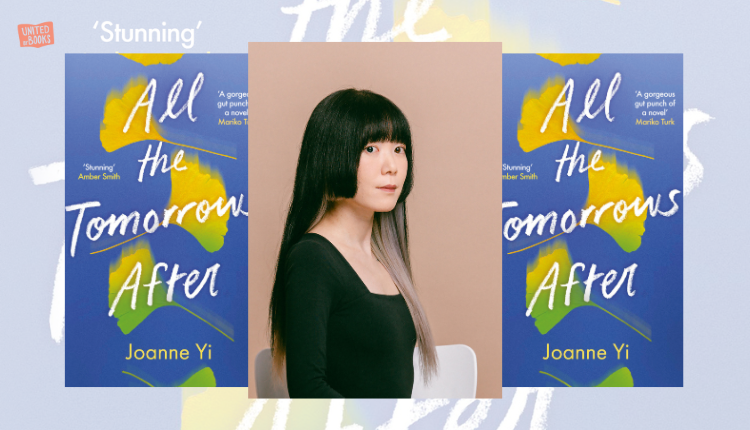
Joanne Yi on the silent language of grief
All the Tomorrows After author Joanne Yi reflects on generational grief, unspoken love, and the silent strength of her Korean family.

All the Tomorrows After by Joanne Yi is a poignant coming-of-age novel about Winter Moon, a Korean American teen navigating grief, fractured family ties, and the unexpected return of her estranged father. To celebrate the release, Joanne is here to tell us her own experience with grief.
Guest post is written by Joanne Yi, author of All the Tomorrows After
A while ago, my family went on a weekend trip. For the first time, my brother and I openly reminisced about our father, who had passed from a prolonged illness nearly five years earlier. We recalled buried memories of him; we candidly addressed the years of his suffering and our anticipatory grief. That evening, in the hush of a remote cabin, we breached a long-standing barrier to grieve as one. It was liberating, and the closest I had felt to my brother since adolescence. We have since returned to our usual silence, and I have now realized we are carrying on a generational tradition.
Our family is adept at evasion. We seldom vocalize our shared grief, focusing instead on lighthearted conversations and more feasible challenges. My mother only briefly endures any mention of those difficult years before veering to the next subject. Our relatives rarely bring my father up, as though determined to preserve the calm.
Some days, I burst with wanting to talk about him, to keep his memory thriving. I wish to affirm, through those who knew him best, that my father truly was the man I remember. He sure loved his tacos, didn’t he? I randomly long to ask. Wasn’t he the best at woodworking? He was kind, right? I miss him. Inevitably, though, I am struck by the guilt of possibly undermining our hard-earned veneer, of triggering discomfort.
I grew up observing the custom of suppressed emotion. Whenever my grandmother told me to ddook, I knew to stanch my tears. The utterance itself was punctuation, with enough weight to halt a child’s wail. Ddook. You’ll be fine. Do you want to worry your parents? Don’t make a scene. I gradually learned to veil my hurts with cheer. I became a dam and was commended for my strength.
Before my halmoni was a grandmother, a widow, a mother of five, she was a young woman escaping North Korea at the onset of the Korean War. My child self was vaguely aware of her sadness in an abstract way, as a part of who she had always been to me. As an adult, now able to fathom her history, I ache for the grief she bore over decades.
Upon her passing, there were no spoken reflections or regrets, no opportunity for a conversation. When our extended family visits my grandparents’ graves, we honor them with two traditional bows, palms flat against the ground. After, we quietly gaze down at their stones, before quietly returning to our lives. While our respect of lost loved ones is communal, our grief has always been self-contained.
Still, I understand I am never owed anyone’s vulnerability. My parents, specifically, tended to mourn in isolation so as not to burden anyone with their emotions. For years, they were under pressure to survive amid their considerable losses—to keep their business afloat, to provide for their children, to shield them from as much pain as possible. To fully acknowledge their sorrow would likely have meant buckling under the heft of their collective trauma.
In the present, my brother and I bear the family inheritance. Through unspoken agreement, we uphold the silence. He has taken on our father’s business and the familiar ritual of survival. I have channeled my grief onto the page, in part to overcome the shame of vulnerability; this has culminated in my debut young-adult novel, All the Tomorrows After. We endure, holding close all that we shared during our trip. In silence, perhaps, but also in tacit love and understanding.
