

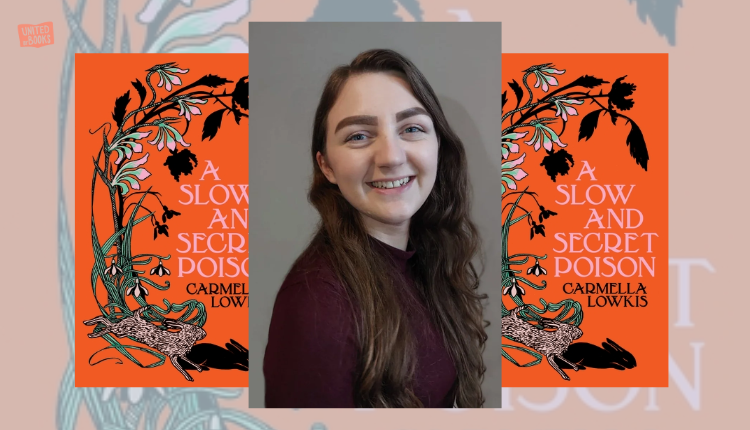
Carmella Lowkis on Queer History, the 1920s, and A Slow and Secret Poison
Carmella Lowkis explores the queer history, gothic atmosphere, and sapphic romance behind her 1920s-set novel A Slow and Secret Poison.

Set in 1922 Wiltshire, A Slow and Secret Poison is a gothic mystery steeped in secrets, desire, and the quiet resilience of queer lives lived under constraint. Carmella Lowkis’s novel follows Vee Morgan, a young woman seeking refuge as a gardener at the decaying Harfold Manor, where she becomes drawn into the house’s dark history and an intense connection with its reclusive mistress, Arabella Lascy. To celebrate the release, we invited Carmella Lowkis to write about discovering queer history.
This guest post is written by Carmella Lowkis, author of A Slow and Secret Poison.
Growing up in rural England, I felt completely disconnected from LGBTQ+ culture. I didn’t know of any local queer role models or history that might have given me a clue about where I fit in. But all of that changed when my grandparents took me along with them to an exhibition on photographer and designer Cecil Beaton at a nearby gallery.
I had never heard of Beaton before, but in his interwar photographs I discovered a black-and-white world of artists, writers and aesthetes challenging the norms of gender and sexuality – and all of this taking place in my home county of Wiltshire! These ‘Bright Young Things’ would often descend on their friends’ country houses for glamorous parties, with many famous LGBTQ+ figures among their ranks: Siegfried Sassoon, Vita Sackville-West, Virginia Woolf, Evelyn Waugh, Stephen Tennant, Rex Whistler, Ivor Novello, Cecil Beaton himself – and the list goes on.
This led to a research obsession that eventually inspired me, more than ten years later, to write my latest historical fiction novel. A Slow and Secret Poison is a gothic mystery and dark sapphic romance set in a 1920s Wiltshire country manor. But the glittering photographs of Beaton’s circle could only take me so far in my writing journey, and I had to start asking: behind that glitz, what did queer – and specifically sapphic – lives look like a century ago?
The 1920s and 30s were a fascinating time in the history of sexuality and gender. Thanks to the workforce gaps left by World War I, more women were suddenly required to enter ‘male’ professions, taking up the reins of factory work, manual labour and even uniformed roles. Yet instead of being grateful for their contribution, some feared that women would never want to return to the domestic sphere of marriage and motherhood as a result, and that men, for their part, would be pushed towards effeminacy – a future that was profoundly unsettling to the socially conservative.
Along with the moving times, fashions were also transforming. In a rebellious move away from the structured outfits of the Victorians, young people favoured more informal, androgynous ensembles. The 20s saw the emergence of the ‘boyettes’ – young women who chose to crop their hair and sport the classic drop-waisted silhouette of the era, even daringly opting for trousers on occasion. Dancer, actress and famous bisexual Josephine Baker was an iconic example of this look. For me, this opened up a world of historical butch fashion possibilities, an aesthetic which I had a lot of fun playing with in my book.
Accordingly, the 1920s saw a growing concern over so-called ‘sexual inversion’. For the first time, lesbianism was the subject of Parliamentary discussion when MPs voted, in 1921, to criminalise sex between women. This was blocked, however, supposedly on the grounds that it would only put the idea of lesbianism into more women’s heads. In the literary sphere, Radclyffe Hall’s landmark 1928 lesbian novel The Well of Loneliness caused waves of outrage that led to an infamous obscenity trial, and the book’s suppression.
But it was also possible for queer women to operate under the radar. Novelists Virginia Woolf and Vita Sackville-West were able to sustain a long-term, on-off romantic relationship thanks to the cover of their respective marriages. Unlike Radclyffe Hall, Virginia Woolf avoided any vitriol with her modernist classic Orlando, published in the same year at The Well of Loneliness. In the novel, a fictionalised version of Sackville-West appears as the main character, an Elizabethan nobleman who lives for centuries, magically turning into a woman along the way. An advertisement for the book in the New Yorker even got away with boldly asking readers: ‘How would you like to change your sex?’ The two women’s collected correspondence in Love Letters: Vita and Virginia informed A Slow and Secret Poison heavily – not least because Sackville-West, like my protagonist, Vee, was a keen gardener.
When I set out to write A Slow and Secret Poison, I wanted to stake a claim to the rural queer history of the 1920s. The novel is entirely fictional, but the remarkable lives that inspired it were beautifully real.
